
Taming Scope Creep: Strategies to Protect L&D Project Timelines and Budgets
Updated: Sep 6
Scope creep rarely arrives as a single massive request, it creeps in through a dozen tiny additions. Here is how to establish boundaries, frame trade-offs, and protect your delivery dates.
Executive Summary
Scope creep in L&D projects is a quiet killer. It rarely arrives as a single, dramatic overhaul; instead, it enters as a series of seemingly innocent requests: "Can we just add a section on X?" or "Leadership wants a short module added." In isolation, each ask feels reasonable. Combined, they quietly transform a streamlined two-week sprint into an bloated two-month ordeal.
Managing scope isn't about being unhelpful or saying "no" to stakeholders. It is about establishing transparent boundaries, treating changes as formal business trade-offs, and building operational flexibility directly into your project architecture.
Key Takeaways (TL;DR)
Scope creep is cumulative: Small additions compound over time to jeopardize launch dates and budgets.
Establish the change process early: Set up a formal change-request protocol before work starts so scope conversations are routine, not adversarial.
Anchor to a 1-Page Charter: Explicitly document what is in scope, what is out of scope, and what defines "done."
Offer trade-offs, not refusals: Frame new asks around cost or timeline impact (e.g., "We can add X, but it shifts the launch date by two weeks").
Build intentional buffer room: Scope projects at 85–90% capacity so your timeline can absorb minor tweaks without turning every ask into a crisis.
Anatomy of Scope Creep: From Intentional to Inflated
When L&D teams operate without clear boundary mechanisms, small additions steadily compromise project health:

4 Defense Mechanisms to Protect Timelines & Budgets
1. Establish a Formal Change-Request Process Early
The best time to define how you handle changes is during project kickoff, not defensively mid-project when tension is high.
Establish a simple, documented change protocol from day one:
Log the Request: Every new feature, module, or topic request is formally logged.
Assess Impact: Evaluate the request against two metrics: Budget Impact and Timeline Shift.
Formal Approval or Deferral: Present the impact assessment to the primary project sponsor to either approve the adjusted timeline or defer the request to "Phase 2."
Why it works: It shifts the dynamic from an informal hallway argument into a standard business decision. Stakeholders respond much better to visual timeline data than to verbal pushback.
2. Leverage a 1-Page Project Charter
Documentation isn't just administrative paperwork—it is an active boundary tool. Before development begins, secure stakeholder sign-off on a simple, 1-page charter containing:
In-Scope Deliverables: Exact number of modules, scenarios, assets, or media types.
Explicitly Out-of-Scope Items: Topics, tools, or delivery channels that will not be addressed in this release.
Definition of "Done": Explicit criteria (e.g., SME sign-off + Level 1 assessment complete) that mark the project complete.
When a mid-project ask arrives, the charter allows you to show—rather than argue—that the request falls outside the original contract.
3. Frame Asks in Terms of Trade-offs (Never Just "No")
Positioning L&D as a strict gatekeeper creates friction with leadership. Instead of shutting down a request with "We can't do that," reframe the conversation around business trade-offs.
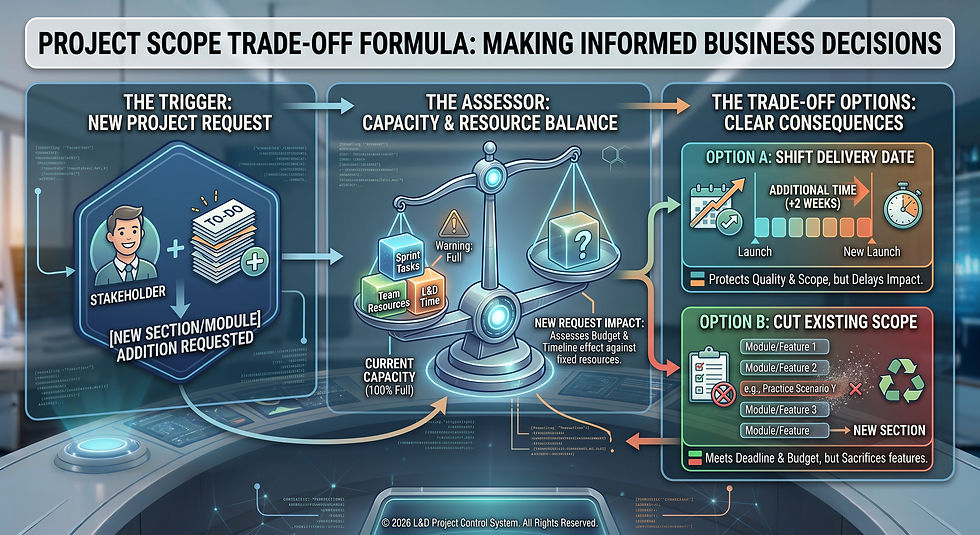
This puts the decision-making power back into the stakeholder's hands while making the real-world operational cost completely visible.
4. Build an Intentional Scope Buffer
A project planned at 100% capacity is built to fail. The slightest unexpected delay or minor edit turns into an immediate fire drill.
Instead, intentionally scope project timelines at 80–85% of total capacity. Reserving a 15% buffer gives your design and development team the breathing room required to absorb minor feedback loops gracefully without blowing past deadline commitments.
Summary Comparison: Reactive vs. Proactive Scope Management
Dimension | Reactive Scope Handling | Proactive Scope Architecture |
Change Process | Handled informally via emails or ad-hoc chats | Formal log evaluating budget & schedule impacts |
Boundaries | Vague expectations; "We'll build what you need" | Written 1-page charter defining "In" vs. "Out" |
Stakeholder Syncs | Saying "Yes" to everything until deadlines slip | Presenting clear trade-off options (Scope vs. Time) |
Planning Capacity | Scoped at 100% full workload | Scoped at 85% capacity with intentional buffer |
Practitioner Playbook: Actionable Boundary Steps
Create Your Charter Template: Draft a standardized 1-page charter template with explicit "In Scope" and "Out of Scope" sections for every new intake.
Standardize the Impact Question: Train your instructional designers and project managers to ask: "What existing requirement or deadline shift are we trading to accommodate this ask?"
Log Phase 2 Backlog Items: Maintain a public "Phase 2 Backlog." When a stakeholder proposes a great idea that is out of scope, park it in Phase 2 so they feel heard without compromising the current release.
Final Thoughts & Discussion
Protecting project timelines isn't about being uncooperative—it's about protecting the quality of the learning solution and the sanity of your team. By setting clear boundaries, establishing trade-off frameworks, and documenting scope upfront, L&D shifts from an order-taking production house to a strategic business partner.
Over to you: How does your L&D team handle mid-project scope changes? What strategies or trade-off frameworks have helped you protect your project deadlines?


Comments